where reputation meets reality

Designed to Fail
When a cleanliness score drops, the instinct is to look at the housekeeping team. Rarely does anyone look at the design elements. But the design elements are often where the problem started — and where it was always going to end up.
2/15/20264 min read
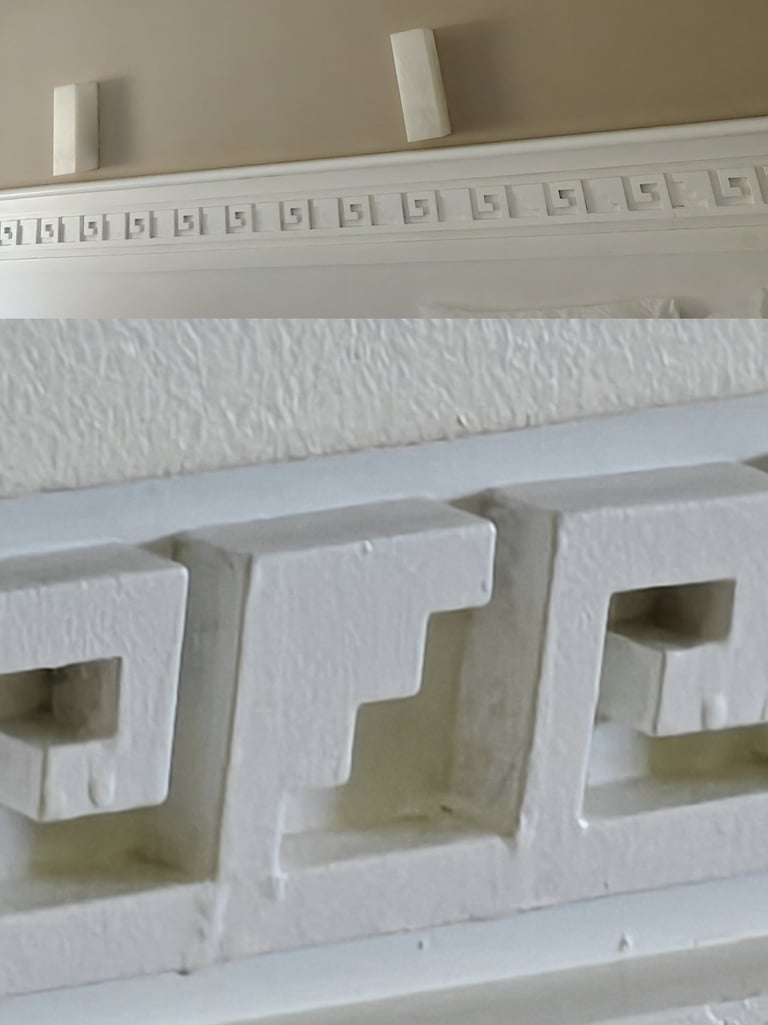
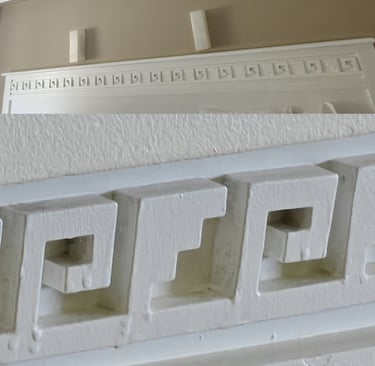
Simply put, this room was designed to fail long before a guest ever checked in.
This photo shows Greek key detailing — that interlocking, geometric border pattern that has signaled luxury in interior design for about three thousand years. In this particular room, it was everywhere. The headboard. Above both mirrors. Across the front of the desk. Every dresser drawer. Wherever a surface edge needed to make a statement, the Greek key was there to make it.
It looks extraordinary in a rendering. It photographs beautifully at install. The procurement team probably loved it. The design firm definitely put it in their portfolio.
And it is an absolute operational nightmare hiding in plain sight.
What the rendering does not show
Look at the bottom image closely. Those are paint runs.
Not the result of a careless maintenance team. Not a bad hire, or a rushed schedule, or a failure of effort. Paint runs are what happen when a painter — working with standard tools, under standard time pressure, in a recessed groove pattern that no brush was designed to navigate — tries to get coverage into corners that were never meant to be painted in the first place.
The reality of resort and cruise ship design is that nobody who comes up with the design or approves the design ever has to paint it. Or repaint it. Or touch it up between guest complaints about scuffs. The design decision and the operational consequence were separated by an org chart and about four layers of approval. By the time the maintenance team inherited the problem, it had already been locked in concrete — literally, in some cases.
The cleaning problem nobody modelled
Set the painting issue aside for a moment, because there is a second failure embedded in the same detail.
Think about housekeeping. Every recessed groove in that pattern is a collection point. Dust. Product residue — hairspray, sunblock spray, dry shampoo. Humidity, which in a Caribbean or Mexican coastal property is not a seasonal concern but a permanent operating condition. All of it settles into those grooves and stays there, because there is no efficient way to clean that pattern. There is no tool designed for it. It gets done by hand, slowly, incompletely, if it gets done at all. Not because they are undertrained or unmotivated, but because the geometry of the pattern makes thorough cleaning physically impractical within the time allocated to turn a room. In a high-occupancy property, a room turn is measured in minutes. There is no version of that constraint in which detailed carved millwork gets the attention it requires.
What happens next is predictable, and it shows up in the data before anyone in operations can articulate why the numbers are moving. The cleanliness scores take a hit. A guest photographs the buildup in one of those grooves — and guests absolutely will photograph it, because that is what guests do now — and posts it alongside their review of room condition and cleanliness. That review sits on TripAdvisor or Google for the next several years. Prospective guests read it. Booking behaviour shifts in ways that are almost impossible to trace back to a design specification signed off before the property opened.
The cascade that starts before check-in
This is the part that operators tend to underestimate: how far upstream a design failure actually originates, and how long downstream it continues to pay out in costs.
Maintenance hours expand to compensate for a surface that cannot be efficiently maintained. Repaints get scheduled more frequently than they should be, and they never quite look right, because touching up a complex recessed pattern without visible bleed lines requires a level of precision and time that a maintenance budget does not accommodate. The furniture itself ages poorly relative to simpler alternatives, which means accelerated replacement timelines and capital expenditure that was not modelled at the outset. None of that originates at the staff level. It was baked in the moment someone chose form over operational reality.
None of this is visible in the rendering. None of it appears on the mood board. It lives entirely in the gap between what something looks like on day one and what it costs to sustain across year three, year five, year ten. That gap is where guest experience actually lives.
The question that should be in every design brief
The operators who are consistently winning on guest satisfaction scores, cleanliness metrics, and review sentiment are not winning because they have better staff. They are winning because someone, somewhere in their development process, established a different standard for design approval. They don't just ask, "does this look good?", they ask, "how well is this going to hold up?" before the first blueprint is even approved.
That question changes the conversation at the specification stage. It brings maintenance into the design review. It asks housekeeping what they can actually clean in a turn. It treats operational reality as a design constraint rather than an afterthought.
The properties that skip that question do not discover the cost immediately. They discover it gradually, in declining scores and ballooning labour hours and guest photographs of things that were always going to end up looking exactly like that. By the time the problem is visible, it is also structural. You cannot renovate your way out of a design philosophy.
Design is the first operational decision a property makes
The conversation in hospitality tends to locate service failures at the staff level. Training gaps. Attitude. Turnover. Those are real factors, and they deserve real attention. But they are downstream of something more fundamental.
A property that is difficult to maintain will be undermaintained. A surface that is impossible to clean thoroughly will not be cleaned thoroughly. A detail that photographs beautifully at install and deteriorates predictably under normal operating conditions will deteriorate under normal operating conditions. These are not mysteries. They are the logical outcomes of design decisions that did not account for the humans who would have to operate the space day after day, at scale, under resource and time pressure.
Guest experience is a design problem. That does not diminish what happens at the staff level. It simply locates accountability where it actually belongs: in the decisions made long before the first guest ever checked in.
The Greek key was always going to fail. It was specified to fail. The only question was how long it would take for the cleanliness scores to say so out loud.
Contact
Intel@coastalrecon.ca
© 2026. All rights reserved.
Stay Informed
Get insights on fixing guest experience leaks